There’s been a lot of talk in the past year about how “we’re in this together” and “together, we can,” and it’s less popular to pontificate on the beauty and benefit of solitude. I often find myself trying to make sense of human behavior by comparing it to that of dogs, and there are times when the similarities just don’t align; however, sometimes the similarities between us and them are too striking to ignore. Recently I was skimming articles on the American Kennel Club’s website and one in particular caught my eye. The article, “The Importance of Teaching Your Puppy How to be Alone,” might well have been found in a self-help or parenting book for two-leggeds. See for yourself: “There is one critical step (of training) you don’t want to forget — teaching your pup how to enjoy being alone. Although it’s tempting to spend every waking minute with your new puppy, you aren’t doing them any favors. Eventually, you’ll have to leave them on their own. It’s likely your new puppy has never been alone before. Start by teaching them to be alone while you are still in the house. A safe confinement area… is perfect for this purpose. If you use (this) appropriately, they will see their confinement area as a place to relax rather than as punishment.” I wonder how many of us could say that our alone time offers us peace and relaxation. How many of us can honestly say that we are okay with only our own company for any time at all?
It seems like humans have taken enormous steps backwards in the years since handheld devices became ubiquitous. Gone are the times we must sit with our thoughts; gone is our ability to enjoy being alone, because now we never have to be alone. If you observe any line, whether it’s a coffee shop, department store, or DMV, you’ll likely see a queue of strangers comprised of bowed heads and busy thumbs. Even the duration of a red light now seems too interminable a time spent out of touch with the rest of the world. It makes me wonder about the extent to which our compulsion to connect has affected our ability to know ourselves and be okay with our own company with no external entertainment, validation, or distraction.
In Runaway Bride, Julia Roberts’s character has an epiphany when her third or fourth fiancé asks how she prefers to eat her eggs; she realizes that with each new partner in her life, she loses herself to their interests and preferences. While this mutability takes on greater significance in the story than whether she likes her eggs poached or scrambled, it serves to represent her reluctance to reflect on her own identity, choosing instead to assume that of her current love interest, like human tofu. For all the improbable scenarios squeezed into the 90-minute rom-com, this is one aspect of the film that rings uncomfortably true for many of us.
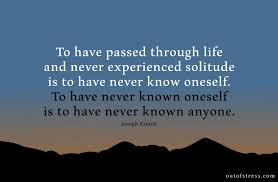
The gift of self-knowledge, of learning who we are outside of the sway (or pressure) of anyone else, is arguably one of the greatest we can give ourselves. Why do we measure our value by the status of our social calendar or intimate relationships? I challenge any adult to live alone in a dwelling they have selected, filled, and occupied without the input or influence of another, to look around this space and see their personality reflected, to spend their time in this home doing what they choose, eating what and when they like, compromising nothing. I am confident that this taste of autonomy and luxury of being selfish will inoculate them against allowing anyone into their space (whether it is their home, their heart, or their mind) who does not improve upon the existing condition. In the absence of meaningful, intentional time with oneself, we’re vulnerable to the belief that any company is better than no company. However, when we have experienced the power inherent in learning ourselves, supporting ourselves, and creating a rich and healthy life for ourselves, it will take a remarkable opportunity or person to tempt us into sharing it.
Of course it feels nice to know that our puppies (or our children) need us and seek us out for comfort and support, but what feels good to us is not always in the best long-term interest of those we love. Teaching our puppies (and children) how to develop independence (physical, emotional, and financial—okay, so maybe the pup will never be fully financially independent!) is absolutely non-negotiable, even though at the time it feels as though we’re being unloving by providing those little pushes. And everyone is different. Some of us are straining at the leash to be on our own at 18 and others might be 21 before they’re prepared to pursue their interests, live on their own, and realize the potency of being fully capable of providing for themselves. But when they do, I dare anyone to try taking that superpower from them!
 PartWolf