Every day Best and I spend about an hour hiking through the woods. For him, it’s time to be (mostly) autonomous, deciding which scents to linger over and what trails to follow. For me, it’s time to be on alert for snakes, deer, briars, or anything else that could put my furry explorer in danger. Occasionally while I’m in head-on-a-swivel mode, a random thought will occur and I have time to go down a figurative rabbit hole while Best tries to go down a literal one.
Apropos of nothing other than my growling belly, today I thought of Doritos. And candy corn. And how for years I would joke that I just “couldn’t trust” myself to keep those in the house because I was unable to resist them. I even felt proud of my self-awareness and commitment to keep those delicious temptations out of reach. But wasn’t I really also saying that my dedication to my own health was so shaky, and my confidence in my ability to steer clear of unhealthy foods so low that I couldn’t risk being around them for fear of what I might do? Shouldn’t I instead have been working on better choices and thought patterns so that my life wouldn’t be a series of avoiding whatever triggered my weaknesses?
And while in the big scheme of things my appetite for certain junk food probably isn’t a tragic flaw because I know I can trust my logical brain to override whatever my Id is whispering, I did feel convicted to think of my commitment and consistency to what matters and the effect my resolve has on others.
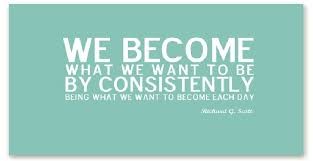
Commitment and consistency are hard sometimes. Many of us struggle with fidelity even to the promises we make to ourselves; is it any wonder that we’re challenged to remember our expressed allegiance to others? And yet, it is the desire and decision to prioritize someone else, or a value, or a task, that reveal so much about us. Especially when it would be so much easier not to.
When I was driving to work a week ago, to an office on a university campus, I listened to a news story about a mass shooting, the 67th of the year according to this news outlet, at a college. The story included sound bites from various stakeholders expressing various ways to solve the problem of campus violence. None were new: enact stricter gun laws, enforce tougher punishment for such crimes, beef up security on school grounds, and so on. In the spirit of transparency, I readily admit to being a responsible gun owner and career-long educator –despite being described as everything from “gun nut” to “bleeding heart teacher,” I see no similarity to myself in labels so rigid and extreme– and I cringe to think of teachers with concealed carry authority or laws that conjure images of peace officers banging on my door demanding that I relinquish my safely-kept, respectfully- handled weapons. The only side that I find myself landing hard on is the one that maintains that unless and until there is a daily commitment to situational awareness, regular reviews of safety plans, and zero tolerance of anyone who does not respect that safe school campuses require ceaseless commitment to protecting their inhabitants, it will always feel as though we’re living in a state of shock and regret, reactivity instead of proactivity.
Having spent countless hours on campuses over thirty years, I know that heightened awareness of locked exterior doors, strangers on campus, and intruder drills can feel like more duties heaped onto an already-overworked educator. And in the days following a school shooting we’re all on our best behavior, making sure our classroom doors are secured and that any suspicious activity is reported; sadly, tragically, that hypervigilance diminishes. Until the next time.
Individually and collectively we don’t always do so well with sustained engagement. We mean well, sure, but it seems as though with each passing year we’re losing the muscle memory to take responsibility, recognize what is important, and re-commit each and every day to give our best. We can blame that on any number of things: over-indulgent parenting, our culture of busy-ness, our deeply-ingrained belief that nothing bad will ever happen to us, and so on.
As I’ve grown older I’ve identified clues that I believe reveal so much, maybe everything I need to know, about a person. And again, I put myself front and center of my analysis and evaluation of human nature. I’ve found that if someone tells me something like, “You exercise your dog an hour a day? I wish I could do that but I like sleep too much,” “I don’t know how you eat healthily; I like McDonald’s burgers way too much to do that!” “I know my kid walks all over me, but it’s just easier than fighting them all the time,” then I can conclude that this probably isn’t someone I can count on to show up for me every day. They’re not even showing up for themselves. And I try to have as little interaction with people like this as possible.
I’m not suggesting that stricter gun laws or harsher punishments aren’t valid ways to address gun violence, specifically at schools, but I am suggesting that our society has quite a lot of people (myself included sometimes) who struggle to remain committed to what’s best, healthy, and safe for themselves, their partners, their families, and until we can get to the heart of this problem, I don’t feel hopeful that more restrictions or convictions will be the great solution we’d like it to be, any more than my junk food-free home is strengthening my ability to regularly, intentionally make better snack choices.
 PartWolf